Crossing the Ocean: The Unbreakable Spirit of the Belgrade Kalmyk School
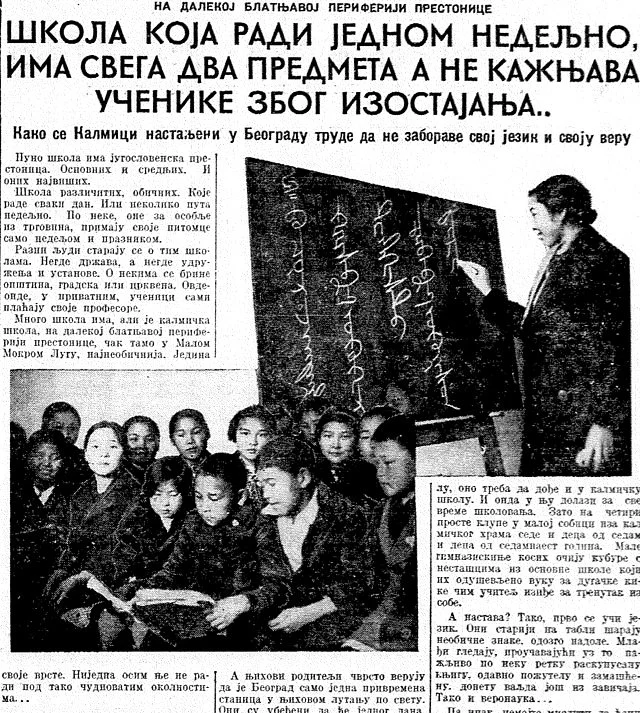
"Бузр цандгт киисҗ үкхәр, теңгст чиҗ үксн деэр"
(Translation from Kalmyk language: “Better to drown while swimming across the ocean than to die in a dirty puddle.”)
In 1939, on the muddy outskirts of Yugoslavia’s capital, a remarkable act of cultural survival was quietly taking place. Far from the steppes of their ancestors, a community of Kalmyk refugees gathered in the shadow of the Belgrade Khurul—the first Buddhist temple in Europe—to ensure their children would not forget who they were.
Look closely at the historic photograph above. You see a teacher standing before a chalkboard, carefully tracing their native script. Below her, the eager, upturned faces of Kalmyk children watch intently. They were a people in exile, navigating the devastating aftermath of war and displacement, yet they pooled what little they had to run a school. They met not just to learn grammar, but to keep the soul of their people alive.
On that chalkboard, a timeless and powerful Kalmyk proverb was taught:
“Бузр цандгт киисҗ үкхәр, теңгст чиҗ үксн деэр”
A Lesson in Resilience
This proverb was not just a language exercise; it was a manifesto for a displaced people. For the Kalmyks of Belgrade, the "dirty puddle" represented the quiet, slow death of assimilation, apathy, and forgetting their heritage in a foreign land. The "ocean" was the vast, terrifying, but noble struggle to maintain their identity, their faith, and their community against all odds.
They chose to swim the ocean. They built a temple, they educated their young, and they held onto their dignity. Even as the dark clouds of World War II gathered over Europe in 1939, threatening to scatter them once more, the Belgrade Kalmyks refused to let their culture fade into the mud.
Help Us Carry the Legacy Forward
Today, the physical walls of the Belgrade Khurul may be gone, but the spirit of that classroom remains a profound testament to human resilience. However, the history of the Kalmyk diaspora and the precious cultural artifacts of this era are at risk of being lost to time.
We need your help to keep swimming.
Your generous contribution ensures that the incredible story of the Belgrade Kalmyks—and the rich cultural heritage they fought so hard to protect—is preserved for future generations.
By becoming a benefactor today, your donation will directly fund:
Educational Outreach: Developing programs that teach the Kalmyk language, history, and the beautiful traditional scripts to youth today.
Cultural Exhibitions: Funding traveling exhibits and online memorials to share this unique chapter of European and Buddhist history with the world.
The refugees of 1939 crossed an ocean of hardship so their culture could survive. Do not let their legacy end in a forgotten puddle of history.
Every contribution, no matter the size, makes a difference. Stand with us, honor their bravery, and help us keep the history of the Kalmyk people alive.
Sources:Image Source: "Vreme" Daily, Belgrade (1939 Archive).Historical Context: Milenković, T. (1998). Kalmici u Srbiji 1920-1944.Archives: Special thanks to the historical archives of the Belgrade Buddhist Colony and the Politika photo documentation center.