From Endor to the Eurasian Steppe: What Ewoks Can Teach Us About the Kalmyk Language
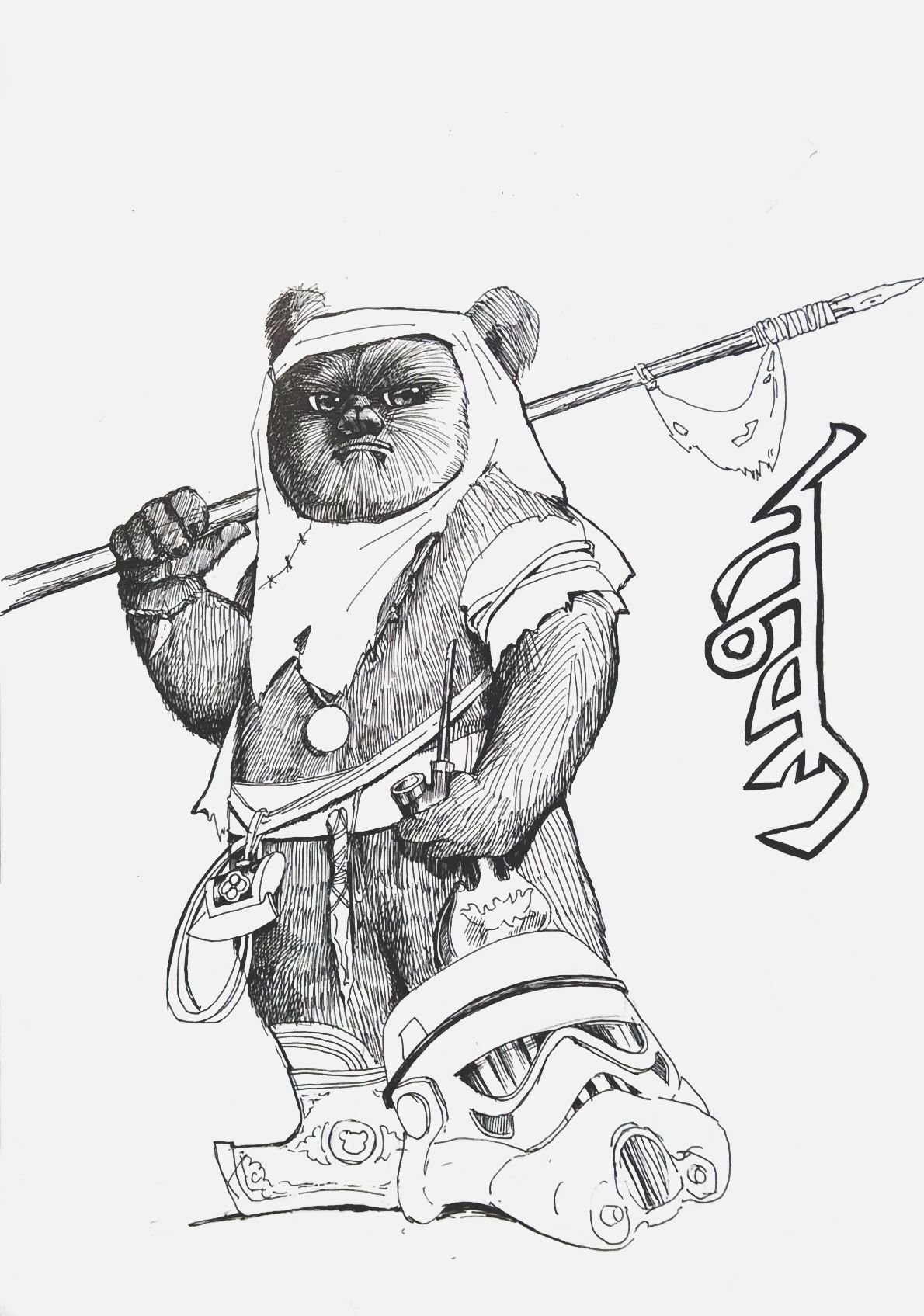
This is a drawing of an Ewok from Star Wars in Kalmyk style, created by the Kalmyk artist Timur Tsonkhlaev.
At first glance, Ewoks and the Kalmyk language seem to belong to entirely different universes. One lives among redwood forests on the moon of Endor, beating stormtroopers with logs and clever traps. The other echoes across the windswept steppes near the Caspian Sea, carrying centuries of nomadic history, Buddhism, and oral tradition. Yet when you look a little closer, the fuzzy inhabitants of Star Wars and the real-world Kalmyk language share something deeply human: the power of small cultures to survive, adapt, and tell their stories.
Ewoks: Small, Strategic, and Linguistically Curious
When Ewoks first appeared in Return of the Jedi, they surprised audiences. How could teddy-bear-sized forest dwellers defeat the technologically advanced Galactic Empire? The answer wasn’t strength—it was local knowledge, cooperation, and culture.
Ewoks have their own language, complete with rhythm, repetition, and emotional expressiveness. Though fictional, it feels real because it follows patterns found in human languages: intonation to convey meaning, communal storytelling, and sound symbolism. Their speech reinforces who they are—a tight-knit society shaped by their environment.
George Lucas reportedly wanted Ewoks to represent underestimated communities: small, indigenous, and dismissed by outsiders, yet capable of resilience and ingenuity. In that sense, Ewoks are not just cute aliens; they’re a metaphor.
Kalmyk: A Living Voice of the Steppe
The Kalmyk language, spoken primarily in the Republic of Kalmykia in southern Russia, is the only Mongolic language native to Europe. It belongs to the Oirat branch of Mongolic languages and carries within it the memory of migration, exile, and survival.
Like the Ewoks’ language, Kalmyk is deeply tied to place and culture. Traditionally, it was spoken by nomadic herders, shaped by oral epics, Buddhist philosophy, and a close relationship with the natural world. Vocabulary reflects this heritage—there are rich terms for animals, landscapes, kinship, and spiritual concepts that don’t translate neatly into global languages.
Yet Kalmyk, unlike Ewokese, faces real danger. It is classified as endangered, with many younger Kalmyks growing up speaking Russian instead. Language shift, political history, and globalization have all played a role in silencing voices that once traveled freely across the steppe.
The Underdog Parallel
This is where Ewoks and Kalmyk truly meet.
Both represent cultures that are often underestimated by dominant powers. In Star Wars, the Empire sees Ewoks as primitive and irrelevant—and pays the price for that arrogance. In the real world, minority languages like Kalmyk are frequently dismissed as impractical or obsolete in a globalized society.
But languages aren’t just tools for communication; they are repositories of worldview. When a language disappears, a unique way of understanding time, nature, humor, and community disappears with it.
The Ewoks’ victory is fictional, but the lesson is real: survival doesn’t always come from size or dominance. It comes from adaptability, collective memory, and cultural confidence.
Why Pop Culture Matters for Endangered Languages
Pop culture has an unexpected role to play in language preservation. Fans learn Klingon, Elvish, and even Ewok-inspired speech patterns for fun. Meanwhile, real languages like Kalmyk struggle for learners, resources, and visibility.
What if we borrowed a page from Star Wars fandom?
Storytelling, games, music, and online communities can make languages feel alive and relevant. When people fall in love with a culture—whether fictional or real—they want to learn its language. The success of Ewoks as a cultural symbol shows that even small, unfamiliar languages can capture global imagination if they’re framed with curiosity and respect.
From Fiction to Responsibility
Ewoks remind us that small cultures matter. Kalmyk reminds us that this isn’t just a narrative device—it’s a responsibility.
Supporting endangered languages doesn’t require grand gestures. It can start with learning a few words, listening to traditional songs, reading bilingual poetry, or simply acknowledging that linguistic diversity is as important as biodiversity.
In the end, Ewoks live safely on Endor, preserved forever on film. Kalmyk lives—or fades—based on human choices.
If we cheer for Ewoks overthrowing an empire, perhaps we can also cheer for real-world languages like Kalmyk to survive, adapt, and continue telling their stories—soft-spoken, resilient, and powerful in their own way.